
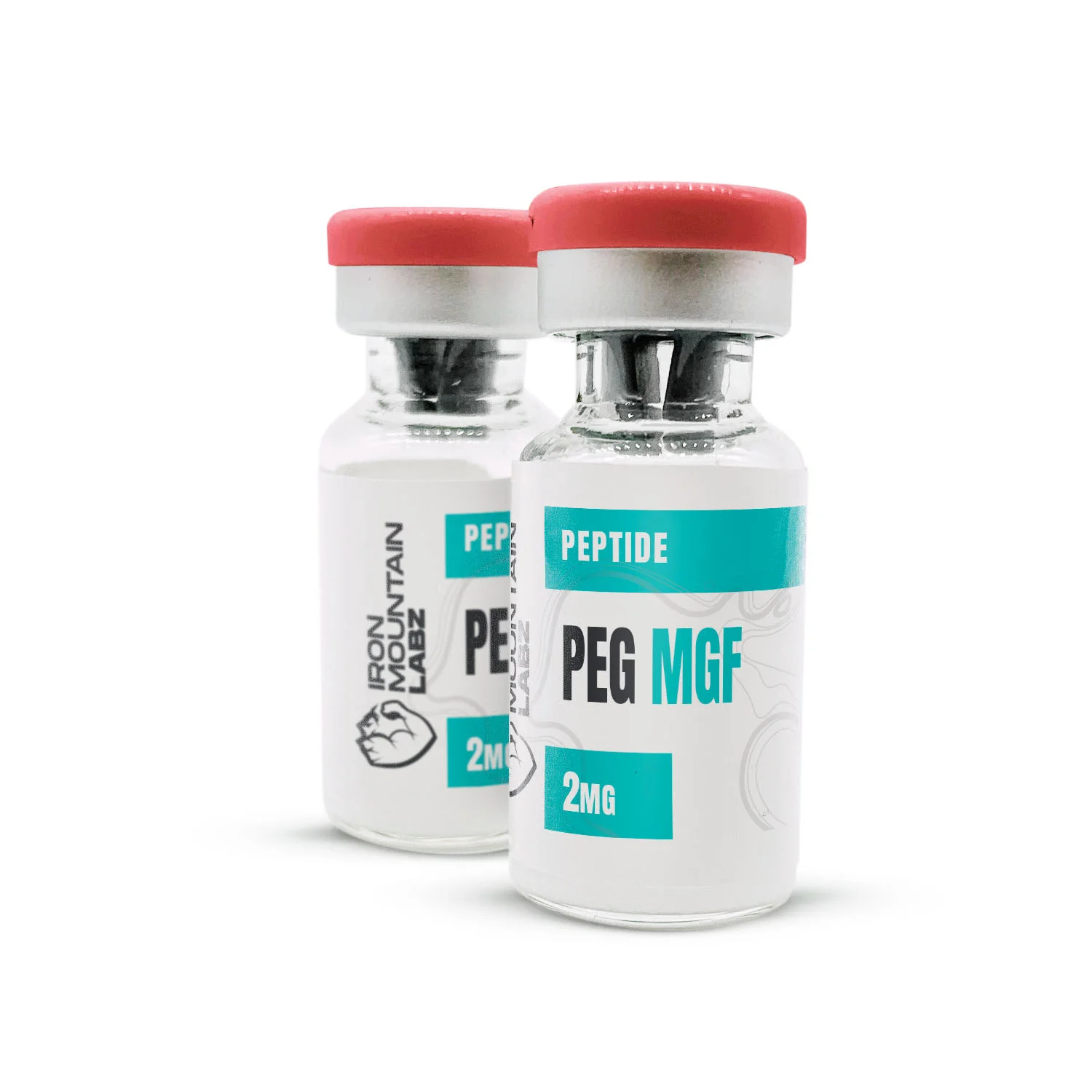
What is PEG-MGF (PMF)?
PEG-MGF Peptide, or Pegylated Mechano Growth Factor, is a modified version of the IGF-1Ec splice variant. The body naturally produces the base MGF peptide in response to muscle tissue breakdown or mechanical overload. However, native MGF suffers from an extremely short half-life, lasting only minutes in the bloodstream. To solve this, scientists attach a polyethylene glycol (PEG) molecule to the peptide. Consequently, researchers in the UK, USA, and Australia utilize PEG-MGF to study sustained systemic muscle repair and regeneration.
Mechanism: Satellite Cell Proliferation and Half-Life
PEG-MGF functions primarily by stimulating the division of myoblasts and satellite cells. These stem cells are essential for the growth and repair of muscle fibers. The addition of the PEG chain prevents the peptide from binding to IGF-binding proteins and protects it from enzymatic degradation. This modification extends the half-life from minutes to several days. Therefore, it serves as a critical tool in Germany and France for investigating how prolonged growth factor exposure impacts chronic tissue damage.
Breakthroughs in Hypertrophy and Tissue Remodeling PEG-MGF Peptide
The most significant research application for PEG-MGF involves its ability to increase the number of muscle nuclei. By activating satellite cells, the peptide provides the necessary cellular machinery for muscle hypertrophy. Unlike standard IGF-1, which promotes cell differentiation, MGF specifically focuses on cell proliferation. Scientific studies in the USA and Spain indicate that PEG-MGF significantly enhances the recovery rate of damaged skeletal muscle. Thus, it remains a high-priority compound for exploring treatments for musculoskeletal injuries and degenerative wasting.
Systemic Effects vs. Localized MGF
Researchers frequently distinguish between the localized action of natural MGF and the systemic reach of PEG-MGF. Because the pegylated version remains stable in circulation, it can reach and treat damaged tissues throughout the entire body. This makes it particularly effective for studying systemic conditions or multiple injury sites simultaneously. Moreover, the peptide helps reduce localized inflammation by accelerating the transition from the inflammatory phase to the remodeling phase. Consequently, biotech firms in Australia and the UK prioritize it for advanced sports medicine research.
Quality Standards and Laboratory Handling
Professional laboratories in Spain, Germany, and the UK require maximum chemical purity for valid results. High-quality PEG-MGF usually arrives in a lyophilized state with a purity of 98% or higher. You must store the vial in a refrigerated environment between 2°C and 8°C for long-term molecular stability. After you reconstitute it with bacteriostatic water, the solution remains stable for several days. Handle the vial gently and avoid vigorous shaking to protect the pegylated structure. These strict protocols guarantee accurate results for your muscle physiology and regenerative science studies.


Reviews
There are no reviews yet.