
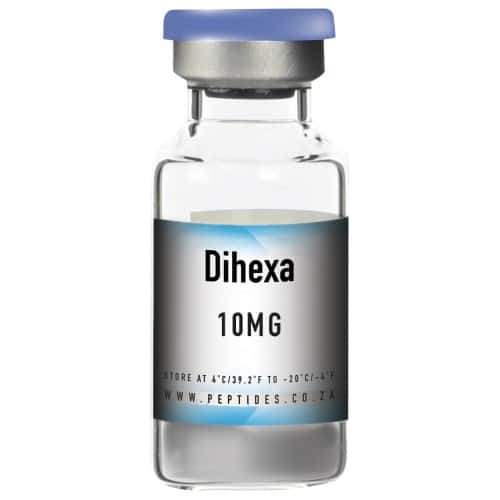
What is Dihexa (PNB-0408)?
Dihexa (PNB-0408), blood-brain barrier-permeable angiotensin IV analog. Originally developed by researchers at Washington State University, it is a small-molecule peptide that scientists call a “neurogenic lonidamine.” Specifically, Dihexa targets the Hepatocyte Growth Factor (HGF) and its receptor, c-Met. Consequently, researchers in the UK, USA, and Australia study Dihexa for its unprecedented ability to promote synaptogenesis. Early preclinical data suggests it is seven orders of magnitude more potent than Brain-Derived Neurotrophic Factor (BDNF). This high potency makes it a primary focus for investigating the reversal of cognitive deficits.
Mechanism: HGF/c-Met Pathway Potentiation
Dihexa functions by binding with high affinity to the HGF protein. This binding enhances the activity of the c-Met receptor, which is critical for tissue regeneration and neural survival. Once activated, the HGF/c-Met system triggers a cascade that supports synaptic plasticity and the formation of new functional connections. Furthermore, the peptide helps protect existing neurons from excitotoxicity and oxidative stress. Therefore, it serves as a critical tool in Germany and Canada for investigating neurodegenerative disorders like Alzheimer’s and Parkinson’s. This precise molecular activation helps researchers observe the repair of damaged neural circuits in laboratory models.
Breakthroughs in Memory Recovery and Nerve Repair With Dihexa (PNB-0408)
The most significant research application for Dihexa involves its potential to restore memory in cases of severe cognitive decline. Scientific studies in the USA and Spain indicate that the peptide can reverse lead-induced cognitive impairment in animal models. Researchers observe that Dihexa facilitates “dendritic arborization,” which increases the complexity of neural branches. Additionally, the peptide is studied for its role in peripheral nerve regeneration and muscle re-innervation. This makes it a high-priority compound for laboratories exploring the boundaries of neuro-regeneration. Thus, it remains a primary focus for neurological health science in Italy.
Regulatory Status and 2026 FDA Reclassification
As of April 23, 2026, the regulatory landscape for Dihexa has shifted significantly in the United States. The FDA removed Dihexa from Category 2 (Bulk Substances that Raise Significant Safety Concerns) following the withdrawal of safety concern nominations. While the FDA’s Pharmacy Compounding Advisory Committee (PCAC) is scheduled to review its official status in July 2026, this move has lessened certain restrictions for US compounding pharmacies. However, Dihexa is not FDA-approved for human use and remains a research-only compound in many jurisdictions. Researchers must verify local laws in the UK and Australia regarding the handling of investigative peptides.
Quality Standards and Laboratory Handling
Professional laboratories in Italy, Germany, and the UK require maximum chemical purity for valid experimental results. High-quality Dihexa usually arrives as a white lyophilized powder with a purity of 98% or higher. You must store the powder in a cool, dry place between 2°C and 8°C, or below -18°C for long-term molecular stability. After you reconstitute it with an appropriate solvent, keep the solution refrigerated and avoid repeated freeze-thaw cycles. Handle the vial gently to avoid mechanical stress on the peptide structure. These strict protocols guarantee accurate results for your neuro-pharmacology and cognitive enhancement studies.
Reviews
There are no reviews yet.