
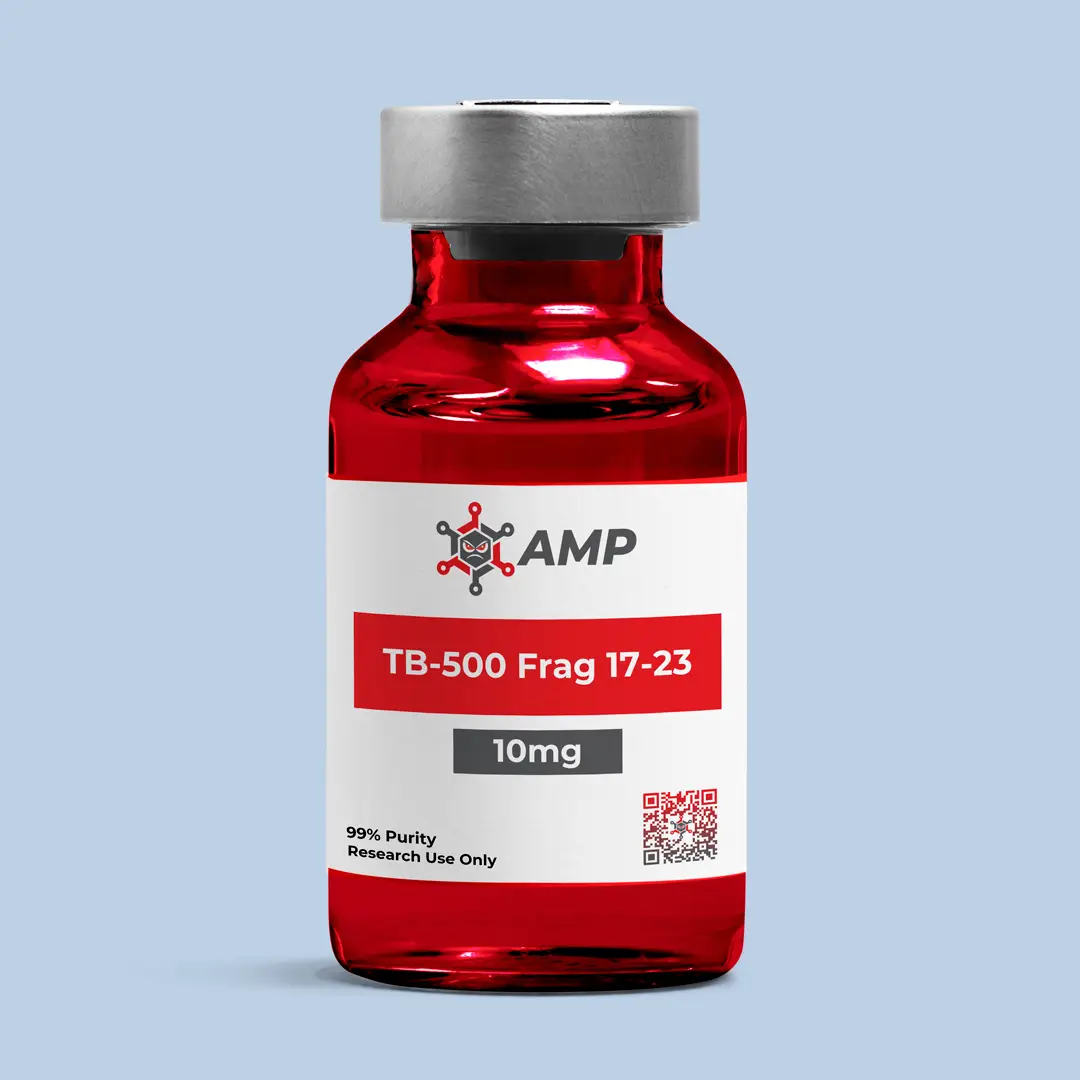
What is Frag 17-23 (TB-500 Fragment)?
Frag 17-23 (TB-500 Fragment) is a synthetic heptapeptide representing the central active domain of the larger Thymosin Beta-4 (T$\beta$4) protein. Often referred to in research circles as the “core” of TB-500, this seven-amino acid sequence (Ac-LKKTETQ) is responsible for the majority of the protein’s regenerative effects. Consequently, researchers in the UK, USA, and Australia study Frag 17-23 for its high efficiency in promoting cell migration and tissue repair. Its smaller molecular weight allows for easier synthesis and potentially faster biological uptake compared to the full 44-amino acid Thymosin Beta-4 molecule. Therefore, it serves as a primary tool for investigating localized healing and structural protein modulation.
Mechanism: G-Actin Binding and Angiogenesis
Frag 17-23 functions as the primary G-actin sequestering site of the Thymosin Beta-4 molecule. By binding to globular actin, it prevents its polymerization into filaments, thereby maintaining a pool of available actin monomers within the cell. This regulation is essential for cellular motility and the “spreading” of cells to injured areas. Furthermore, the peptide triggers the production of vascular endothelial growth factor (VEGF). Therefore, it serves as a critical tool in Germany and Canada for investigating angiogenesis—the formation of new blood vessels from existing ones. This precise molecular action helps researchers observe improved nutrient and oxygen delivery to compromised tissues in laboratory models.
Breakthroughs in Wound Healing and Hair Follicle Research With Frag 17-23 (TB-500 Fragment)
The most significant research application for Frag 17-23 involves its ability to accelerate the repair of skin, muscle, and tendons. Scientific studies in the USA and Spain indicate that the peptide promotes the migration of keratinocytes and endothelial cells to wound sites. Researchers observe that Frag 17-23 can stimulate the differentiation of stem cells into specialized repair cells. Additionally, the peptide has shown promise in studying hair follicle activation and growth by stimulating the migration of follicular bulge cells. This dual-action repair profile makes it a high-priority compound for regenerative medicine. Thus, it remains a primary focus for dermatological and orthopedic research in Italy.
Quality Standards and Laboratory Handling
Professional laboratories in Italy, Germany, and the UK require maximum chemical purity for valid data. High-quality Frag 17-23 usually arrives as a lyophilized (freeze-dried) powder with a purity of 98% or higher. You must store the vial in a freezer at -20°C for long-term molecular stability. After you reconstitute it with bacteriostatic water or a specialized saline solution, keep the solution refrigerated between 2°C and 8°C. Handle the vial gently to prevent mechanical stress on the 7-amino acid sequence. These strict protocols guarantee accurate results for your tissue engineering and wound healing studies.

Reviews
There are no reviews yet.