
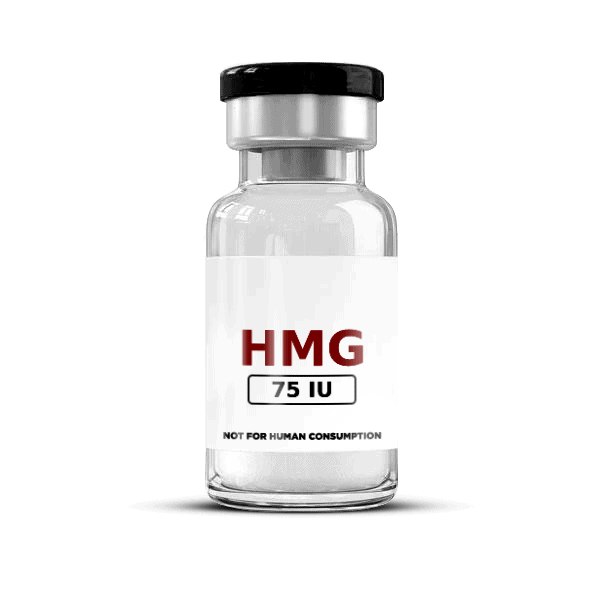
What is HMG (Human Menopausal Gonadotropin)?
HMG (Human Menopausal Gonadotropin), also known as Menotropin, is a highly purified preparation of gonadotropins extracted from the urine of postmenopausal women. Unlike HCG, which primarily mimics Luteinizing Hormone (LH), HMG contains a balance combination of both Follicle-Stimulating Hormone (FSH) and Luteinizing Hormone (LH), typically in a 1:1 ratio. Consequently, researchers in the UK, USA, and Australia study HMG for its comprehensive impact on the entire reproductive system. It is recognize as a primary tool for investigating the complex hormonal requirements for gamete maturation—the production of eggs in females and sperm in males.
Mechanism: Dual Gonadotropin Signaling
HMG functions by directly stimulating the gonads, bypassing the pituitary gland. The FSH component binds to receptors on the granulosa cells (in females) or Sertoli cells (in males) to promote the growth and maturation of follicles or the production of sperm. Simultaneously, the LH component binds to theca cells or Leydig cells to stimulate the production of essential precursor hormones like androstenedione and testosterone. Therefore, it serves as a critical tool in Germany and Canada for investigating the “synergy” between FSH and LH. This precise molecular signaling helps researchers observe a more complete reproductive response compared to using selective hormones alone.
Breakthroughs in Spermatogenesis and Assisted Reproduction Of HMG (Human Menopausal Gonadotropin)
The most significant research application for HMG involves its role in treating male factor infertility and inducing ovulation in complex female models. Scientific studies in the USA and Spain indicate that HMG is often superior for stimulating spermatogenesis in men with hypogonadotropic hypogonadism because it provides the necessary FSH signal that HCG lacks. Researchers also observe its utility in Controlled Ovarian Stimulation (COS) protocols, where it is used to develop multiple mature follicles for laboratory study. This dual-action capability makes it a high-priority compound for reproductive endocrinology. Thus, it remains a primary focus for fertility research in Italy.
Comparison: HMG vs. HCG
In comparative pharmacology, HMG is often studies alongside HCG to evaluate their different roles in the HPG axis. While HCG is an LH mimetic use to stimulate testosterone or trigger the final “ovulatory surge,” HMG is requires for the earlier, longer process of follicle or sperm development. Researchers observe that while HCG maintains testicular volume, HMG is often requires to restore actual fertility (sperm count). Therefore, it serves as a critical tool for investigating the distinct pathways of the gonadotrophs. Understanding these distinctions helps researchers in Australia and the UK design comprehensive protocols for endocrine recovery.
Quality Standards and Laboratory Handling
Professional laboratories in Italy, Germany, and the UK require maximum chemical purity for valid experimental data. High-quality HMG usually arrives as a white lyophilize powder with a potency measured in International Units (IU), commonly 75iu or 150iu per vial. You must store the unmixed powder in a refrigerator between 2°C and 8°C. After you reconstitute it with the provides solvent or bacteriostatic water, the solution should ideally be used immediately, though some stabilized versions can be refrigerates for short periods. Handle the vial with extreme care, as gonadotropins are delicate glycoproteins. These strict protocols guarantee accurate results for your reproductive biology and hormonal signaling studies.

Reviews
There are no reviews yet.