
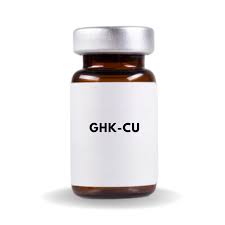
What is GHK-Cu (CU)?
GHK-Cu (Copper Peptide) is a naturally occurring copper complex of the tripeptide glycyl-L-histidyl-L-lysine. First isolated from human plasma in 1973, it is a potent regenerative molecule that declines significantly with age. Consequently, researchers in the UK, USA, and Australia study GHK-Cu for its remarkable ability to improve tissue remodeling and skin quality. The peptide possesses a high affinity for copper (), which is an essential cofactor for several critical enzymes in the body. This unique binding allows GHK-Cu to act as a carrier, delivering copper to cells to trigger healing processes. Therefore, it serves as a primary tool for investigating the reversal of skin aging and the acceleration of wound repair.
Mechanism: Collagen Synthesis and Stem Cell Activation
GHK-Cu functions by modulating the expression of genes involved in the extracellular matrix (ECM). It stimulates the production of collagen, elastin, and glycosaminoglycans, which are the structural building blocks of healthy skin. Furthermore, the peptide activates dermal fibroblasts and attracts immune cells to the site of injury. Therefore, it serves as a critical tool in Germany and Canada for investigating the “resetting” of the human genome to a younger state. This precise molecular action helps researchers observe the thickening of the skin barrier and the reduction of fine lines in various laboratory models.
Breakthroughs in Hair Growth and Anti-Inflammatory Research With GHK-Cu (Copper Peptide)
The most significant research application for GHK-Cu involves its impact on follicular health and systemic inflammation. Scientific studies in the USA and Spain indicate that the peptide can enlarge hair follicle size and stimulate hair growth by inhibiting the production of DHT. Researchers also observe that GHK-Cu acts as a potent antioxidant, neutralizing free radicals and suppressing pro-inflammatory cytokines like IL-6 and TNF-. This dual-action approach makes it a high-priority compound for studying scalp health and chronic inflammatory conditions. Thus, it remains a primary focus for dermatological and anti-aging research in Italy.
Quality Standards and Laboratory Handling
Lastly, professional laboratories in Italy, Germany, and the UK require maximum chemical purity for valid experimental data. High-quality GHK-Cu usually arrives as a distinctive blue lyophilized powder—the color indicating the presence of copper—with a purity of 98% or higher. So you must store the vial in a freezer at -20°C to ensure long-term molecular stability. But after you reconstitute it with bacteriostatic water or a specialized cosmetic base for topical research, keep the solution refrigerated between 2°C and 8°C. Handle the vial gently to prevent the degradation of the tripeptide sequence. And these strict protocols guarantee accurate results for your skin physiology and regenerative medicine studies.
Reviews
There are no reviews yet.