
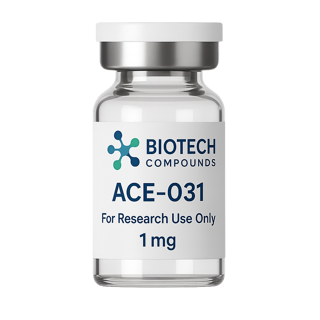
What is ACE-031 (ACI)?
ACE-031 Peptide, often referred to by the abbreviation ACI or the clinical name Ramatercept, is a soluble recombinant fusion protein consisting of the extracellular portion of the activin receptor type IIB (ActRIIB) linked to the Fc portion of human IgG1. This peptide acts as a “decoy receptor” or ligand trap within the TGF-beta superfamily. By circulating in the bloodstream, it prevents negative growth regulators from binding to actual muscle cell receptors. Consequently, researchers in the UK, USA, and Australia focus on ACI for its unparalleled ability to bypass the genetic limits of muscle development.
Mechanism of Action and Muscle Proliferation
The primary function of ACE-031 is the potent inhibition of myostatin (GDF-8) and other related ligands like activin A. Under normal physiological conditions, these proteins act as “brakes” on muscle growth to prevent excessive hypertrophy. When ACI binds to these ligands, it effectively releases those brakes, allowing for significant increases in muscle fiber diameter and satellite cell count. Furthermore, because it targets multiple growth-restricting proteins simultaneously, it often produces more dramatic results than single-target myostatin inhibitors. Therefore, it is a primary subject in Germany and France for studies involving extreme muscle-wasting conditions.
Clinical Research and Physical Benefits of ACE-031 Peptide
During its development and subsequent animal trials, ACE-031 demonstrated an exceptional capacity to increase lean body mass and enhance contractile force. In human phase 1 trials involving healthy volunteers, a single dose was shown to increase thigh muscle volume by over 5% within just 29 days. Beyond pure hypertrophy, research suggests the peptide may also improve bone mineral density and reduce fat mass, creating a more favorable body composition. Consequently, scientists in Spain and the USA utilize the peptide to investigate the reversal of sarcopenia and various forms of muscular dystrophy.
Safety Profiles and Research Discontinuation
While ACI showed immense promise in increasing strength, clinical trials in pediatric populations were terminated prematurely due to specific safety concerns. Researchers observed minor, reversible side effects such as epistaxis (nosebleeds) and telangiectasias (dilated blood vessels). These events likely occurred because the peptide inhibited BMP9 and BMP10, which are ligands essential for maintaining vascular integrity. Therefore, while it remains one of the most powerful muscle-building compounds ever studied, it is strictly classified as a research chemical. Most laboratories in Australia and Germany emphasize careful monitoring of vascular markers during any experimental application.
Global Sourcing and Laboratory Standards
Sourcing ACE-031 for professional research requires adherence to the highest purity standards to avoid contaminants that could skew data. High-quality vials are typically provided in a lyophilized (freeze-dried) state to ensure molecular stability during transit across Europe and North America. For optimal preservation, you must store the powder in a freezer at -20°C. Once reconstituted with sterile or bacteriostatic water, the solution should be kept refrigerated and used promptly to maintain biological activity. By following these rigorous handling guidelines, researchers can safely explore the transformative potential of myostatin inhibition in advanced clinical science.

Reviews
There are no reviews yet.